
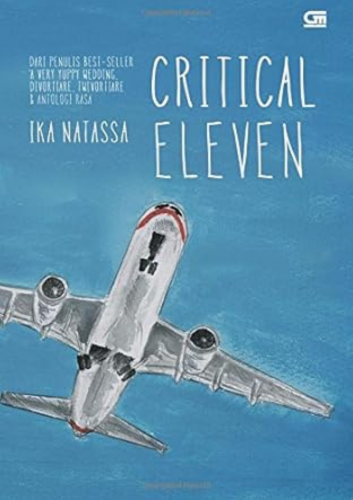
Critical Eleven
Country: Indonesia
Author Name: Nina Andiana
Publisner Name: Gramedia Pustaka Utama
Original Language: Indonesian
Critical Eleven They say that in aviation, the most critical parts of a flight are the first three minutes after take-off and the last eight minutes before landing.
Eleven minutes that determine everything.
Life and love, it turns out, have their own critical eleven too.
Anya, a management consultant based in Jakarta, has her life carefully planned out – a career she loves, independence she treasures, and a calm confidence in her job.
Until she boards a flight to Melbourne and sits next to Ale, a petroleum engineer who works offshore in the Gulf of Mexico.
There’s nothing extraordinary about a stranger sitting beside her on a long-haul flight, except for how everything feels so extraordinarily easy with him.
The eleven hours between Jakarta and Melbourne become their critical eleven, where time and conversation flow like rivers meeting oceans, without force, without end.
For Ale, Anya is unlike anyone he’s ever met.
Intelligent, warm, witty, effortlessly beautiful.
For Anya, Ale is a man who carries himself with silent conviction, humility, and kindness that seeps through the smallest gestures.
Before the
...plane lands, he knows he has found the woman he wants to spend his life with.
Before the plane lands, she knows she is ready to let her life no longer be just her own.
Their courtship is swift yet grounded, their love easy yet deep.
They marry and build a home filled with routines that anchor them amidst Ale’s offshore rotations and Anya’s busy office days.
Their life is filled with small joys – morning coffee, handwritten notes, grocery trips, arguments about things that don’t matter, reconciliations that feel like prayer.
Ale has loved many things in life – his job, the ocean, the certainty of engineering – but loving Anya is the first time something feels like destiny instead of choice.
When Anya becomes pregnant, their love transforms once more.
Ale imagines the child, a son he names Aidan, and his heart expands in ways he never thought possible.
Every offshore rotation now feels heavier, each return home more urgent, his mind constantly weaving dreams about holding his son’s small hands.
But life, like flight, doesn’t always go as planned.
The day they lose Aidan is the day their world collapses.
Anya’s body survives, but her soul fractures in a way neither words nor time could mend.
Ale tries to be her anchor, but grief renders his strength meaningless.
Her silence becomes a wall too high for his hands to reach.
His presence becomes a reminder of what they lost.
Anya, drowned by guilt that her body failed their child, withdraws into herself.
Ale, shattered by helplessness, turns quiet and cold.
Their home that once held laughter becomes a mausoleum of unsaid words, empty cribs, unopened packages of baby clothes, and nights spent awake beside each other, miles apart.
Ale doesn’t know how to fix what’s broken.
He doesn’t know how to hold a woman who flinches at his touch, how to protect her from a pain that grows from within.
He leaves for work offshore earlier and stays longer, unable to bear the sight of his wife’s grief-stricken eyes.
Anya, in her loneliness, folded into guilt and anger until numbness claimed her like a ghost in her own life.
We experience grief in different ways, in the same manner that it comes to us, in the same manner that it consumes us.
Every night since Aidan left, Anya would enter his bedroom and spend her time here, alone.
He would go through his wardrobe and sat on the hardwood floor, slowly folding his clothes while she imagined him wearing them.
When Ale returned after weeks at sea, they faced each other again, words brittle, conversations landmines.
One night, Ale said something he regretted the moment it left his lips.
“Maybe if you hadn’t been too busy with work, Aidan wouldn’t have died.” To Anya, Ale feels like an egotistical man who believes his grief is the greatest wound of all, as if his loss was the only loss that mattered.
As if her pain – the pain of carrying a child within her for nine months, the pain of feeling that life slip away inside her own body – was somehow smaller, somehow lesser.
As if in his sorrow, there was no room left for hers.
In life, there are no heroes and villains, only various states of compromise.
Maybe there is one thing about Ale that Anya couldn’t compromise with.
That remark that he made six months ago.
On Ale’s birthday, his family – unaware of their brokenness – prepared a prank where Anya would pretend she was leaving him.
Ale searched frantically for her all over Jakarta, unaware that for a moment, she truly contemplated leaving.
Her bag was packed, the taxi waiting.
But something – she still doesn’t know what – changed her mind.
She showed up at the party to find Ale waiting desperately.
For the first time in six months, he surrendered to what he had wanted every day, every hour, every minute: he paced towards her and took her in his arms, holding her as tightly as he could.
They realize that grief is love’s echo, and healing isn’t about forgetting the child they lost but remembering him without guilt and without letting go of each other.
Slowly, they rebuild.
Ale learns to speak with vulnerability, and Anya learns to trust that her grief is not a burden Ale is unwilling to carry.
For hundreds of years, writers, philosophers, and even common people like us have tried to find the right language to define love.
Anaïs Nin, a writer, wrote, What is love but acceptance of the other, whatever he is.
The actress Katharine Hepburn once said, Love has nothing to do with what you are expecting to get—only with what you are expecting to give—which is everything.
Anya found her favorite definition on a flight from Sydney to Jakarta, five years ago, days after meeting Ale.
It was in Antoine de Saint-Exupéry’s Airman’s Odyssey, a book she spontaneously bought at the airport: Love does not consist of gazing at each other, but in looking outward together in the same direction.
Just like them now.
Sitting on the floor of Aidan’s room, leaning on the wall, their hands intertwined.
In silence, they looked at every corner they had prepared with love: the wardrobe, the crib, the wallpaper with elephants and giraffes, the toy shelf lined with stuffed animals and Lego helicopters.
Their love does not return to what it was before.
It becomes something new – fragile yet resilient, scarred yet still beautiful.
And just like flight, they know the journey is never without turbulence.
But if love is anything, it is the will to fly again.
Read more
