
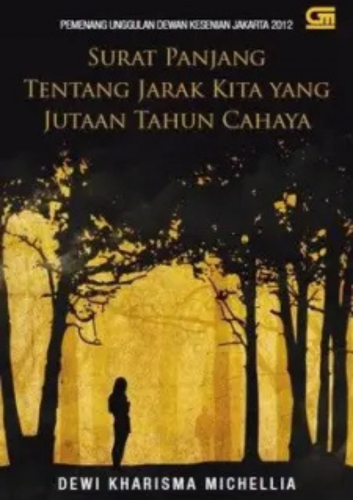
A Long Letter of Our Light Years Distance
Country: Indonesia
Author Name: Ni Putu Dewi Kharisma Michellia
Publisner Name: Gramedia Pustaka Utama
Original Language: Indonesian
Dewi Kharisma Michellia’s A Long Letter of Our Light Years Distance (2013) is an intense epistolary novel that chronicles an one-sided correspondence from a woman to a man who remains silent throughout.
The novel wins the Jakarta Arts Council novel competition and later shortlisted for Kusala Sastra Khatulistiwa (Khatulistiwa Literary Award), a prestigious literary award in Indonesia.
Written in the form of a long letter, the narrative unfolds as a deeply personal and psychological excavation, blending philosophical inquiry, poetic meditation, and emotional vulnerability.
The protagonist’s voice, lucid and unrelenting, gradually reveals the complexities of desire, memory, and estrangement—both from her correspondent and from a society that suppresses female subjectivity.
The novel is significant in Indonesian literature for its radical stylistic and thematic departure from convention.
By choosing the epistolary form, Michellia revives an intimate mode of storytelling while simultaneously subverting it: the absence of response turns the letter into a soliloquy, mirroring the silence often imposed on women in patriarchal cultures.
Her use of lyrical yet intellectually rigorous prose positions the novel between confession and critique, drawing parallels with works
...by Clarice Lispector or Marguerite Duras.
The book interrogates power dynamics in love, language, and authorship, making it a landmark of contemporary feminist writing in Indonesia.
Its legacy lies in how it reclaims female interiority and reshapes the literary landscape.
Michellia offers a raw, unfiltered portrayal of a woman thinking and feeling through her own terms—a rarity in the region’s literary canon.
The novel has since inspired younger Indonesian writers to explore autofiction, epistolary formats, and feminist themes with renewed urgency.
Its quiet defiance and intellectual ferocity continue to resonate, marking it as a touchstone for those seeking literature that blurs the boundary between the personal and the political, the poetic and the polemic.
Read more
